Geely EX2
Contents
The Geely EX2 is a rear-wheel-drive electric hatchback in the E22H family, sold in China as the Xingyuan. Launched in Brazil on November 6, 2025 , it arrived in Pro and Max trims. The original imported specification combines a 39.4 kWh lithium iron phosphate (LFP) battery, a 116 PS motor, and two displays: an infotainment touchscreen and an instrument cluster. The power figure is in metric horsepower (the unit called cv in Brazil), equivalent to about 85 kW.
The electronics are distributed across controllers for the powertrain, battery, body functions, instrumentation, and connectivity. The head unit handles most driver interaction; the other modules handle their respective systems.
This article introduces the Geely EX2 and its electronics, focusing on the Brazilian-market Max in its original imported specification, with the IHU629G head unit. Differences from the Pro and head units used in other markets are noted throughout.
Brazil’s launch specification #
The Pro and Max share a 39.4 kWh LFP battery, a rear-mounted motor rated at 116 PS and 150 Nm, AC charging at up to 6.6 kW, and DC charging at up to 70 kW. The rated range is 289 km under Brazil’s Inmetro test cycle, according to Geely’s Brazilian technical specification sheet . Inmetro is Brazil’s national metrology and conformity-assessment institute; this is a Brazilian range rating, not a WLTP, EPA, or CLTC figure, and those ratings should not be treated as directly interchangeable.
The motor is a permanent-magnet synchronous unit. Mounting it at the rear leaves room for a 70-liter front luggage compartment, in addition to the 375-liter rear trunk. The car is 4,135 mm long, 1,805 mm wide, and 1,580 mm tall, with a 2,650 mm wheelbase. Both axles have independent suspension: MacPherson struts at the front and a multilink setup at the rear.
During AC charging, the onboard charger converts the incoming power to direct current; during DC fast charging, that conversion takes place in the external charging equipment. The respective limits are 6.6 and 70 kW, and charging power varies over the course of a session.
Both trims also share a 14.6-inch infotainment display, an 8.8-inch instrument cluster, six airbags, and an electronic parking brake with Auto Hold. The main differences are in driver assistance, connectivity, and convenience features.
Pro and Max: equipment differences #
The Max adds driver-assistance systems, remote functions, and convenience features to the Pro’s equipment, as detailed in Geely Brazil’s November 2025 launch announcement .
| Equipment | Pro | Max |
|---|---|---|
| Wheels and tires | 15-inch wheels, 205/65 R15 tires | 16-inch alloy wheels, 205/60 R16 tires |
| Cruise control | Conventional | Adaptive (ACC), with Stop & Go |
| Automatic emergency braking (AEB) | Not available | With forward-collision warning |
| Lane-departure warning (LDW) | Not available | Visual and audible warnings |
| Intelligent high-beam control (IHBC) | Not available | Automatic high/low-beam switching |
| Parking cameras | Rear-view camera | 4 cameras; 540° panoramic view (SVM) |
| Driver’s seat adjustment | Manual, 6-way | Power, 6-way |
| Audio system | 4 speakers | 6 speakers |
| Wireless phone charger | Not available | Qi, up to 15 W |
| Dynamic ambient lighting | Not available | 256 colors, 20 brightness levels |
| 4G connectivity and remote functions through the Geely app | Not available | TBOX with eSIM |
| Remote climate control | Not available | Through the Geely app |
LDW only warns when the car leaves its lane. The EX2 Max in this specification has neither lane centering nor active steering correction.
Climate controls are concentrated on the touchscreen, and some functions require two or three navigation steps. Android Auto and Apple CarPlay use a wired connection, as noted in Brazilian news outlet g1’s July 2026 review .
Chinese update and Brazilian production #
In China, the updated lineup gained a 47.14 kWh battery option, a claimed range of up to 480 km under China’s CLTC cycle, and Flyme Auto 2. Higher trims also received a steering-column gear selector and additional driver-assistance features, according to coverage of the August 2026 update .
Brazilian production is expected to bring the larger battery and other improvements, according to Motor1’s October 2026 report .
Local production is scheduled for December 2026, with inventory expected to return to normal in February 2027, according to Geely’s announcement and information compiled by Autoesporte in November 2026 .
EX2 variants and their head units #
The Brazilian IHU629G uses the ECARX E02 C2 platform with Android 9. In the Australian EX2 , the head unit uses Antora 1000, based on the SiEngine SE1000 SoC , and the E22HGP firmware runs Android 11.
In the firmware packages analyzed, the Chinese Xingyuan identifies its head unit as IHU801G, with Android 9, while Malaysia’s Proton e.MAS 5 uses IHU801P, with Android 10.
On the IHU629G, Android communicates with the head unit’s microcontroller (MCU) over SPI. On the IHU801G and IHU801P, that link uses the ECP protocol over UART. On Antora, vehicle communication uses APVP/IPCP services over Ethernet, a cockpit architecture also used in the EX5.
In Europe, the hatchback appears as the Geely E2 , part of the E22H family. The EX5 SUV is also called the E5 in European markets and belongs to the E245 family.
ECUs and software versions #
Each electronic controller is called an ECU, short for Electronic Control Unit. These are computers dedicated to the car’s various functions: the BMS manages the battery, the BCM handles body functions, and so on.
These modules exchange messages over the CAN network. A diagnostic scanner connected to the OBD2 port, the vehicle’s diagnostic socket, queries the ECUs over this network to read faults, measurements, versions, and configuration data.
Each queried field has a code called a DID, or Data Identifier. The scanner uses it to tell the ECU which piece of information it wants to read, such as a part number or software version.
The table lists the part numbers and software versions for 13 ECU identifiers, obtained through diagnostic queries at the OBD2 port. These are the identification fields displayed by the scanner: F187 and F195 correspond to the vehicle manufacturer’s spare-part number and the supplier’s software version, respectively.
| ECU and function | Part - F187 | Software - F195 |
|---|---|---|
| MMI Multi Media Interface Infotainment head unit | 6608387819 | SW0E22H0128H111100000 |
| IPK Instrument Pack / Instrument Panel Cluster Instrument cluster | 6608396917 | 9424301011122 |
| BCM Body Control Module Body functions | 6608114723 | S0140 |
| TBOX Telematics Box Telematics and remote connectivity | 6608389637 | E22HGB1V10A7 |
| XCU X-Controller Unit Integrated powertrain and thermal management | 3600000330 | G10AAA0HV2302300 |
| BMSH Battery Management System Traction-battery management | 6608265526 | GL0LGE22HR1SW024 |
| OBC On-Board Charger Onboard charger | 6608380524 | SWODR002B001A009 |
| EVCC Electric Vehicle Communication Controller Charging communication | 6608341620 | SWEVCCAPP0000012 |
| ESC Electronic Stability Control Stability and braking control | 6608118287 | 02002800900702 |
| EPS Electric Power Steering Electric steering assistance | 6608609233 | SW0E22HA1L080M |
| ACU Airbag Control Unit Airbags and restraint system | 6608402657 | 600 |
| FCS Front Camera System Front camera | 6608473860 | SWV045 |
| PAS Parking Assist System Parking assistance | 6608433103 | SWA00001DT250808 |
On the Brazilian version examined, the diagnostic addresses for the WPC (Wireless Phone Charger) and DSCU (Driver Seat Control Unit) did not respond. These ECUs are present in other configurations of the lineup, depending on the equipment offered in each market.
CAN network and gateway #
CAN stands for Controller Area Network. The ECUs are distributed across different buses. The reference topology groups them into five main networks.
The central gateway is integrated into the XCU and forwards messages between the networks.
The modules shown in the diagram depend on the trim and market. For example, the Brazilian EX2 Pro does not have a TBOX; that module is fitted to the Max.
XCU
Integrated central gateway
- Hybrid CAN
- BMSII
- OBC
- PT CAN
- EVCC
- Chassis CAN
- ACU
- EPS
- ESC
- FCS
- PAS
- Information CAN (IF_CAN)
- IPK
- MMI
- TBOX
- Comfort CAN
- BCM
Access through the OBD2 port #
In the Brazilian configuration examined, the OBD2 socket provides access to a single Classical CAN bus running at 500 kbit/s, through pins 6 (CAN-H) and 14 (CAN-L). In the manual’s wiring diagram, this pair is labeled IF_CAN.
The scanner queries modules on other networks through the gateway. Passive capture at the OBD2 port records traffic on the segment connected to the socket, including messages forwarded by the gateway.
Electronic modules #
Infotainment head unit (MMI) #
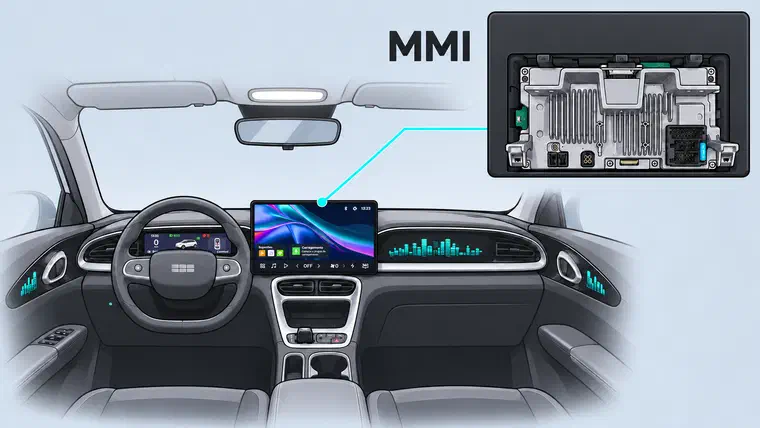
The MMI (Multi Media Interface) is the vehicle’s infotainment head unit. The IHU629G unit, manufactured by Beidou Intelligent Connected Vehicle Technology (BiCV), is labeled EEBADF1.
It uses the ECARX E02 C2 platform and runs Android 9, with the Flyme Auto interface and automotive apps.
The hardware and system have the following characteristics:
| Item | IHU629G - build 111 |
|---|---|
| Platform | ECARX_E02_C2_V1.0 |
| SoC | MediaTek MT8666V , as marked on the board |
| CPU | 8 cores: 4 Cortex-A73 and 4 Cortex-A53 |
| Memory | 6 GB RAM, according to the boot log |
| Operating system | Android 9, API 28 |
| Kernel | Linux 4.4.146 |
| Incremental build | 111 |
| System version | SW0E22H0128H111100000 |
The audio hardware includes an AKM AK7739 DSP, a four-channel TPA6304-Q1 amplifier, and a single-channel TAS6421-Q1 amplifier, identified in the teardown published by Dicas Geely EX2 , a Portuguese-language EX2 blog. The post also shows the head unit’s power, speaker, camera, and USB connectors.
The head unit has two processing layers: the SoC runs Android and the apps, while a separate MCU handles part of the communication with the vehicle’s networks. On the IHU629G, the Android software communicates with this MCU over SPI.
Head-unit software versions #
The head unit has separate versions for the operating system, the Flyme Auto interface, and the MCU firmware. On the IHU629G running system version SW0E22H0128H111100000, the identifiers are:
| Identifier | Value | What it represents |
|---|---|---|
| Android | 9 | The operating-system version that runs the apps |
| Incremental build | 111 | The Android build identifier |
| Full system version | SW0E22H0128H111100000 | The head unit’s software identifier |
| “Version No.” in settings | 1111 | The shortened system identifier displayed on that screen |
| Flyme Auto | E.1.8.0 | The version name shown by this build’s settings app |
The number 1111 comes from the middle of SW0E22H0128H111100000. The settings app reads that identifier and displays only the four characters at positions 13 through 16 in the “Version No.” field. This is why the screen can show 1111 while the Android build is identified as 111.
The Flyme Auto E.1.8.0 name is defined within the settings app itself. It identifies the driver-facing interface, while the full string identifies the head unit’s system software.
The MCU has its own firmware, responsible for part of the communication with the vehicle. The instrument cluster and the other ECUs also maintain their own software versions.
Instrument cluster (IPK) #
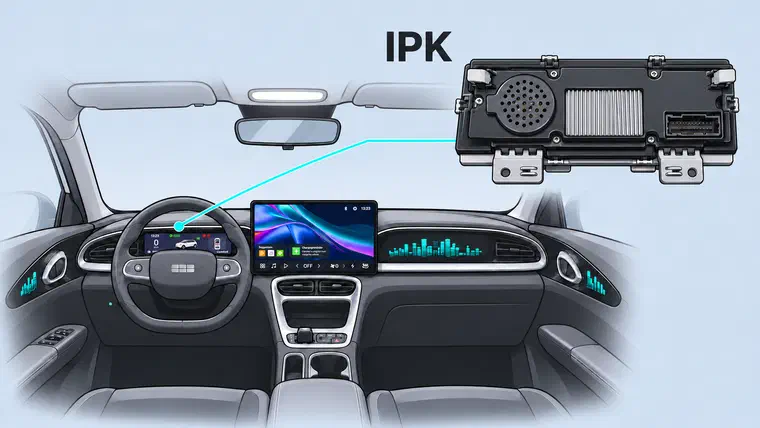
The IPK (Instrument Pack or Instrument Panel Cluster) is the instrument cluster and has its own processing hardware.
The Brazilian cluster examined has an ARK1668E and a Yuntu YTM32B1ME05G0MLH microcontroller. The MCU uses an Arm Cortex-M33 core and runs FreeRTOS.
The two processors communicate over UART. The ARK1668E runs the graphical application, while the MCU handles part of the CAN communication, data persistence, and cluster power sequencing. Each processor has its own firmware.
Information displayed on the cluster passes through a chain of modules: the source controller produces the data, the network carries it, and the cluster software presents it to the driver.
The total odometer reading is maintained by the IPK, with distance data stored in the MCU’s nonvolatile memory. The cluster participates in accumulating and saving the mileage, as well as displaying it on screen.
Body control (BCM) #
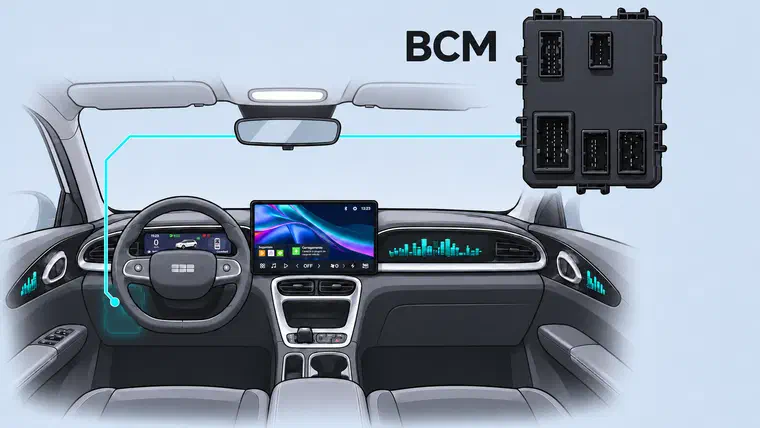
The BCM (Body Control Module) is identified as ZH101A on the Brazilian unit. Its microcontroller is the Infineon/Cypress CYT2B98, from the TRAVEO T2G family. The board also contains interface and driver circuits.
The BCM’s Cortex-M4F application uses Vector MICROSAR OS, an OSEK-derived AUTOSAR Classic real-time operating system. The exact version has not yet been determined.
The BCM handles body functions such as lighting, locks, wipers, and status signals. It also incorporates the immobilizer’s RFID function, described in the Brazilian regulatory approval. Some of these functions can be configured through the head unit. The BCM controls the equipment’s electrical circuits.
Telematics (TBOX) #
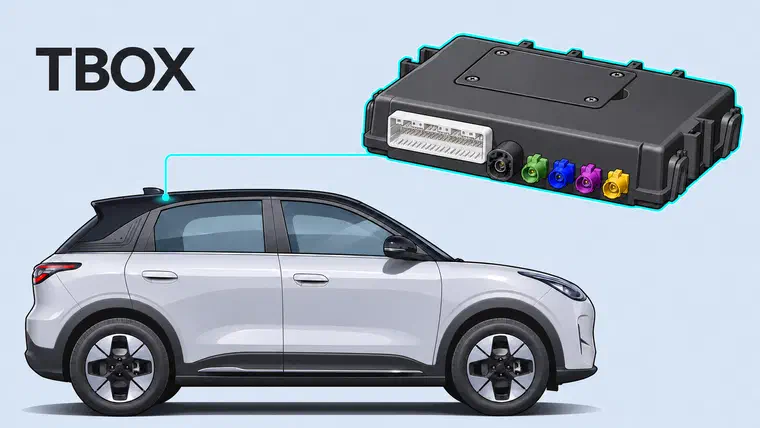
The TBOX (Telematics Box) is the EX2 Max’s telematics module; the Pro does not have this module. It contains the 4G modem and eSIM used to communicate with Geely’s remote services. This connection allows the app to retrieve vehicle information and activate functions such as remote climate control.
Diagnostics report hardware version E22HGB111Q21P001 and boot software identifier YABX018G15.
The TBOX phone number reported by the scanner begins with +46 719, a prefix in the Swedish numbering plan reserved for machine-to-machine (M2M) communication
. The IMSI, which identifies the mobile subscription, begins with MCC 724, assigned to Brazil
.
During a reading near Curitiba, in the southern Brazilian state of Paraná, the scanner showed registration on the network of TIM, a Brazilian mobile operator
, with MCC/MNC code 724-04.
The mobile connection is provisioned for specific functions managed by the TSP (Telematics Service Provider), Geely’s telematics service platform. On the Brazilian Max, internet sharing is not enabled: the car’s data plan supports its connected services but does not provide general internet access for head-unit apps or passengers.
The TBOX connects to the head unit over USB, but Android sees the link as a network interface called tbox0. Commands and information exchanged between the head unit and TBOX travel over this interface. The eSIM is housed in the TBOX itself, separate from the head unit, which offers no menu for changing the carrier or configuring the connection’s APN.
The service manual also refers to the TBOX as OCU(TBox) on a private CAN bus when describing the loss of the MMI_GPS_Info1 message (0x3E1).
There are reports of the TBOX being mounted beneath the shark-fin antenna at the rear of the roof. This location has not yet been confirmed on the Brazilian EX2 Max.
Powertrain control and thermal management (XCU) #
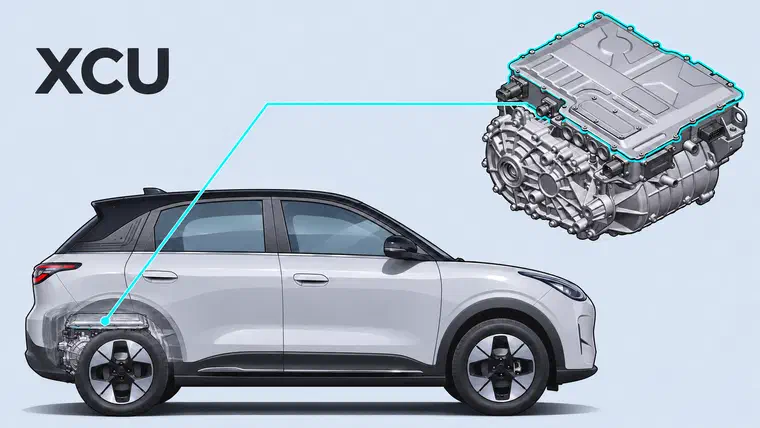
The XCU (X-Controller Unit) brings together powertrain-control and thermal-management functions. Diagnostic readings from this module include motor and torque data, as well as temperatures, the compressor, the fan, and other climate-system components.
In the architecture described by the service manual, the XCU is part of the rear eleven-in-one electric drive assembly, which also incorporates the OBC and DC-DC converter. These functions therefore appear separately in diagnostics but share a physical assembly.
Battery management (BMSH) #
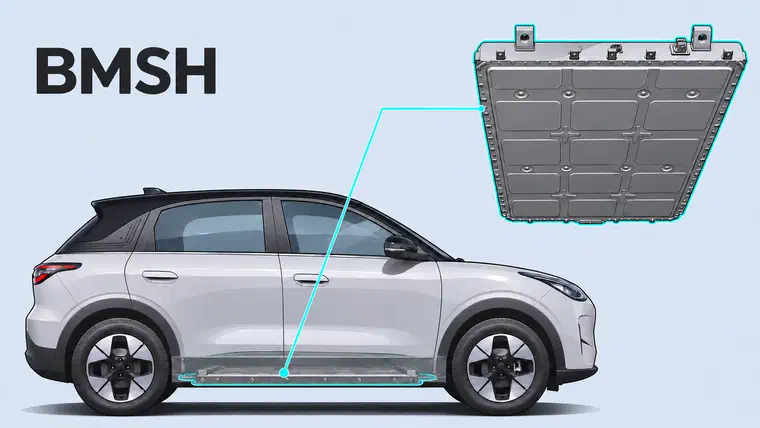
The BMSH (Battery Management System) supervises the traction battery. Its diagnostic data includes state of charge, voltage, current, and pack temperatures. This information also feeds the charge and range indications shown to the driver.
Onboard charger (OBC) #
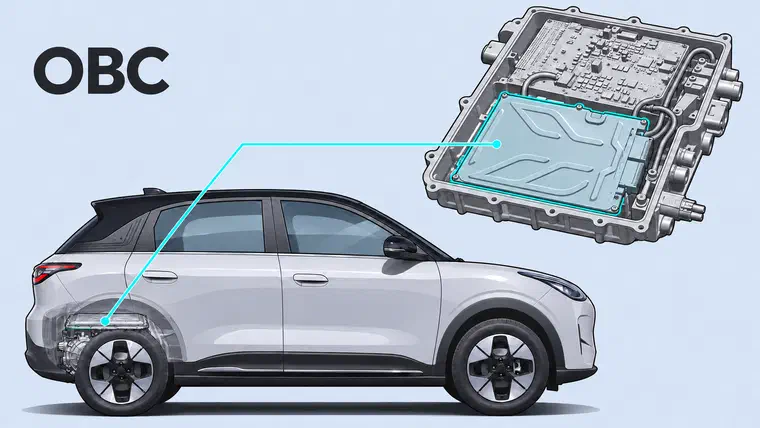
The OBC (On-Board Charger) converts AC power from an outlet or wallbox into DC power to charge the battery. In this EX2 configuration, maximum AC charging power is 6.6 kW.
Charging communication (EVCC) #
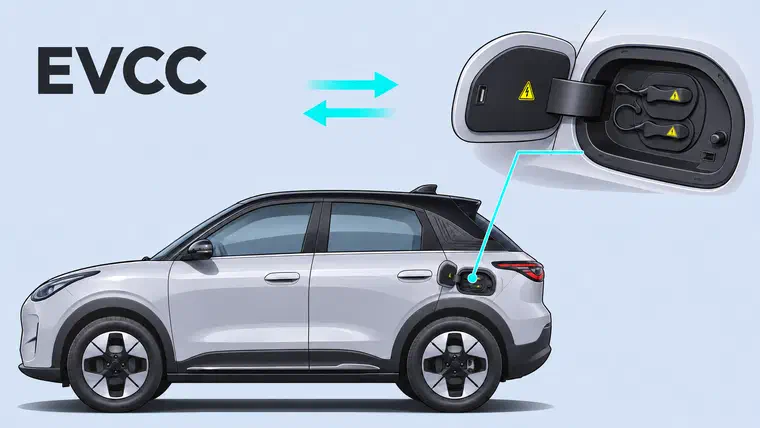
The EVCC (Electric Vehicle Communication Controller), identified as EVC in the diagnostic records, handles charging communication and signaling. It helps coordinate the vehicle and charging equipment, while the OBC performs the electrical conversion during AC charging.
Stability and braking control (ESC) #
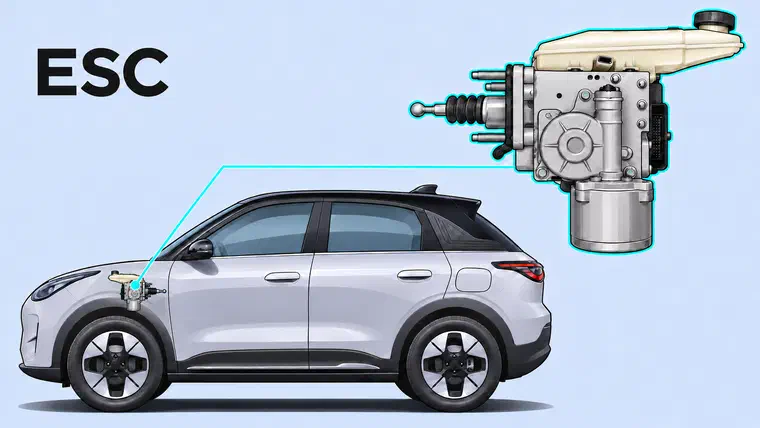
The ESC (Electronic Stability Control) handles electronic stability and braking functions. It uses information such as wheel speeds and vehicle state to coordinate brake interventions and requests for torque reduction.
Electric power steering (EPS) #
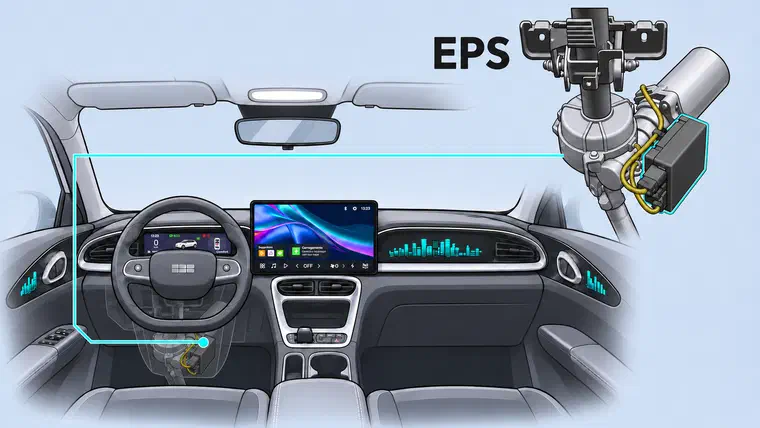
The EPS (Electric Power Steering) controls electric steering assistance. The system adjusts assistance to driving conditions, including vehicle speed.
Airbags and restraint system (ACU) #
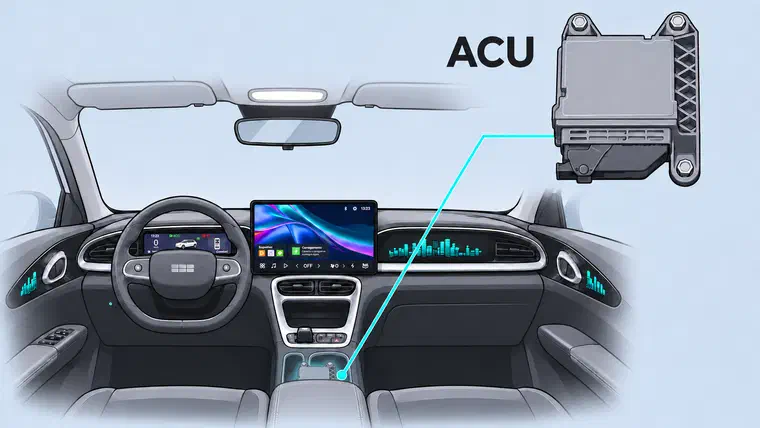
The ACU (Airbag Control Unit) controls the airbags and restraint system. It monitors the circuits and sensors associated with occupant protection and activates the restraint devices in a collision.
Front camera (FCS) #
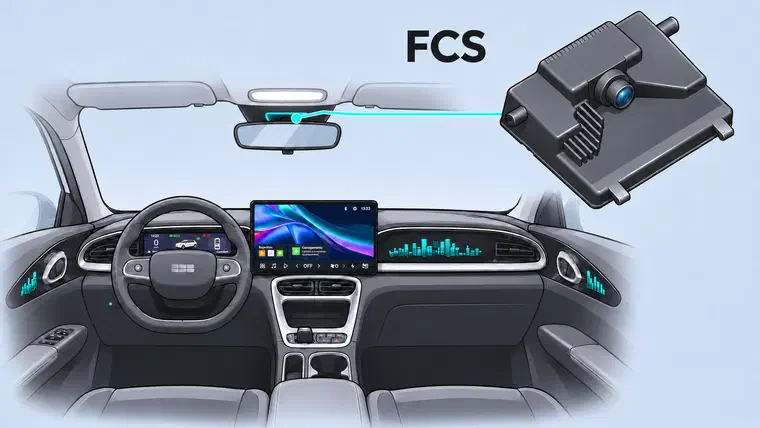
The FCS (Front Camera System) is the forward-facing camera system used by the driver-assistance features. On the Max, it supports lane-departure warning, automatic emergency braking, and intelligent high-beam control.
Parking assistance (PAS) #
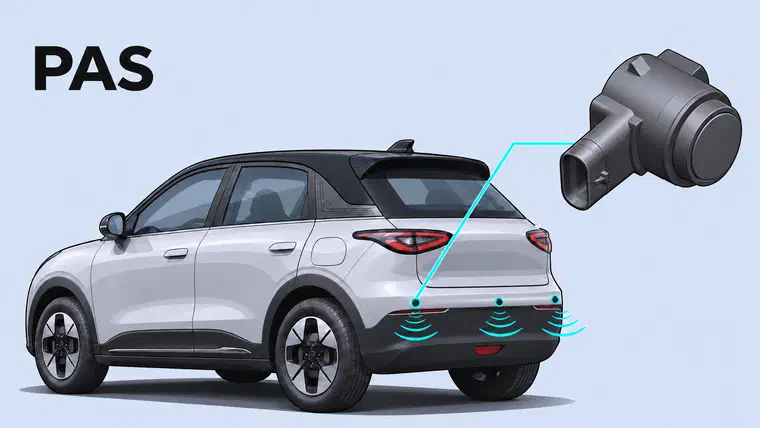
The PAS (Parking Assist System) is the vehicle’s parking-assistance system.
The manual describes three ultrasonic sensors in the rear bumper, along with cameras at the front, at the rear, and beneath the exterior mirrors.
Instrument-cluster and head-unit failures #
The EX2 can continue operating with the IPK or head unit out of action. Powertrain control is handled by other modules, while the cluster and head unit concentrate information display and user-interface controls.
If the IPK stops working entirely, the cluster’s odometer stops accumulating distance. Counting depends on the IPK’s MCU being operational. A failure limited to the display or backlight may leave this MCU running and the mileage still being recorded.
With the head unit out of action, the driver loses access to touchscreen controls and adjustments, including climate controls and vehicle settings. With the cluster out of action, the driver loses the speed indication and the warnings displayed by the IPK.
Equipment configuration #
Beyond version information, the scanner can query module configuration. On the coding screens, these data appear as hexadecimal sequences.
Two recurring fields are F101 and F110. On the Launch X431 Pro Elite scanner used for this article’s queries, they appear as ECU Function configuration and ECU Network Configuration:
| DID | Name | Contents |
|---|---|---|
| F101 | ECU function configuration | 26 bytes in the BCM, 16 in the IPK and MMI, 10 in the XCU |
| F110 | ECU network configuration | An 8-byte map of the modules configured in the vehicle |
F110 is identical across all ECUs queried and describes the configured presence of modules in the vehicle.
F101 varies in both content and length between modules. It may hold ECU-specific settings.
On one EX2 Pro, conventional fixed-speed cruise control was successfully enabled by changing BCM parameters and installing the missing steering-wheel buttons.
The head unit also uses a local 40-byte configuration stored in the MCU and queried by the head unit’s apps and services to select menus, interpret signals, and expose features.
In theory, editing this configuration could enable features such as the Pro’s soundstage function, provided the necessary speakers were installed. In attempts to edit it directly, the values reverted to their previous settings.
Android maintains a table of factory profiles selected by the first two bytes of F101. During startup, a routine can compare the MCU configuration against the corresponding profile and rewrite the 40 bytes if it finds differences.
Anatel regulatory approvals #
Anatel (Agência Nacional de Telecomunicações, or National Telecommunications Agency) is Brazil’s telecommunications regulator, broadly comparable to the FCC in the United States for radio and telecommunications equipment approvals. The numbers below identify Brazilian approvals.
The approved components can be found in Anatel’s public database using the numbers below, listed on page 198 of the Brazilian EX2 owner’s manual .
| Component in the Brazilian documentation | Model | Anatel approval number |
|---|---|---|
| Infotainment head unit | EEBADF1 | 05198-25-17228 |
| Telematics terminal | FLC-WNP286 | 04903-25-09139 |
| Body controller with RFID | ZH101A | 05026-25-13198 |
| Proximity key | TG02 | 05027-25-13198 |
| Wireless charger | WPC-15SX-21490 | 05447-25-14746 |
| Front USB module | 8894837951 / BL-U098A | 00210-25-16846 |
| Rear USB module | TM1103-010016 | 05125-25-15586 |
Updating and unlocking the head unit #
On the IHU629G, Android is updated using a FAT32 USB flash drive connected to the USB-A port. The package folder is copied to the root of the drive, preserving the directory structure and leaving OS/update.zip unextracted.
In the engineering menu, the USB update option starts package verification. The head unit then automatically reboots into Android recovery, which performs the installation.
Unlocking the head unit uses the same path. In this case, the flash drive contains a patch that changes the head unit’s configuration to enable ADB (Android Debug Bridge) over Wi-Fi. Here, “unlocking” refers to enabling Android debugging access. The procedure is described in Dicas Geely EX2’s Portuguese-language tutorial Unlocking the Geely EX2 head unit with a USB flash drive: enabling ADB over Wi-Fi .
Some EX2 variants receive over-the-air (OTA) updates over the internet, with campaigns and packages distributed by Geely’s servers. The system checks for updates available to the vehicle, downloads the packages, and coordinates component installation.
Upcoming articles #
This was a brief introduction to the Geely EX2, its modules, and its electronic architecture. Upcoming articles will examine each part in greater detail: the infotainment head unit (MMI), instrument cluster (IPK), body control module (BCM), and CAN network, including communication between modules and the data flowing through the car.